Saturday, September 26, 2020

Parallels from a space of co-creation


Co-creation

That is the new word which I find myself intrigued by. It tempts me to unravel its layers.

The word has a feel of togetherness and of coming together.

It speaks to me about love, acceptance, shared pride in a task completed.

And it alludes to the personal kept aside for the collective- personal egos/targets/credit.

What better example of a space of co-creation than ‘Theatre’!

For, even a theatrical piece that may be a monologue is put together by a team comprising several individuals.

It is an exhibition of the expertise, skills, ideas and thoughts of each member of that team.  And of how successfully were they able to keep aside the personal agenda and stay focused on the collective team effort.

Co-creation is the word that drew me to Aagaaz.

I wanted to experience for myself how a simple workshop for children was brainstormed over and put together as a meaningful experience for its participants.

I wanted to experience co-creation in practise.

I write today about one such session when I could join the dots to make linkages for myself.

The Grand Patch-up

That was the name of the story through which we opened our module on the theme of ‘Friendship’ with our batch of 7-8 year olds.

The story revolves around the friendship of Mary Sangma and Josana Marak, neighbours and best friends who like to spend time together, co-creating toys using wood.  

All the same, one day when Josana shows Mary a waistband that she has spent several days making, Mary is critical of it. Josana is upset with her response and stops talking to her friend. She refuses to acknowledge Mary’s presence for many days.

An important observation to make here is that while the 2 friends have co-created several toys together, it was a piece created individually by Josana that Mary expresses a dislike for.

Could a feeling of having been left out of the process of creation been at play in Mary’s mind!

How does Mary get their friendship back on track?

The promise of co-creating something new again has Josana let go of her upset. And the 2 friends bridge their differences, literally.

More power to Co-creation!

How did our 7-8 year old friends take to the story?

While all of them commented on the need for a quick apology from Mary’s side, one child displayed co-creation in practice. He happily combined the names chosen by him and his partner to give a new name to the story, ‘The Gold Computer Patch-up’. The joy in his voice while sharing this was simple and potent, a joy laced with love and acceptance.

The next thumbnail in this piece on co-creation exposes my view on theatrically approaching the topic of ‘Friendship’. While I held the view of first exploring the rituals of a healthy friendship before having the children dive into a conflicting situation, another view was to arrive at the layers of a healthy relationship by first gaping at the unpleasant.

What had me keep my personal thought aside and take on the fellow view was an urge to experience another perspective, submit myself to the flow and embrace the unfamiliar so to say.  

Did I do it graciously? I don’t think so!

I did make a discovery though.

That you learn something new only when you embrace the unfamiliar.


Friday, May 29, 2015

A pen

Je suis un stylo.
I am a pen.
Just that!
Innocuous
Banal
Benign
Of no potency.
Unless, put to paper.
It's then that the magic unfolds.
From deep within the soul
pour out emotions.
Feelings buried in the inner recesses of the heart,
find their way up!
Beliefs get worded.
Opinions get firmed. Minds are made.
Words find their way to the brim.
And......the voice is found.

I, an innocuous, banal, benign pen, have different forms.
I may be a painter's brush,
a caricaturist's charcoal,
a cartoonist's nib,
or I may be a blogger's keyboard.

In any form, all I do, is liberate, for
Finding a voice is therapeutic,
It's orgasmic, it's freedom.
Freedom to self-express.
Freedom to let loose into space the confined thought or belief.
Freedom to convey through words.
Words that exist only in language.
Words that are confined to language.
They are not arrows
They do not pierce.
They are not nooses
They do not strangle.
They are not knives
They do not stab.
They are not bullets
They do not kill.
They are just that, W...O...R...D....S, words.

Any harm they cause exists again-
only in language, only in W...O....R....D....S, words.
They are not set in stone.
They change with a changing individual.
They evolve with an evolving being.
They can be taken back, played around with, changed, negated, let loose again.
That's the fun. Enjoy them.

You play around with them too.
Let's debate, discuss, argue, fight a words war.
Let innocuous, banal, benign words
fly around, from all sides, if need be.
Let them move around freely.
Like little honey bees moving in and out of the hive.
Stinging when interfered with.
But harmless most of the time.
You don't kill honey bees with bullets.
It's foolhardy.

Je suis un stylo.
I can fight wars too.
Innocuous, banal, benign word wars.
Pick me up.
Let's fight an equal war.

Je suis Charlie Hebdo.

Wednesday, November 26, 2014

Bhabhi

My brother got married on this day, 25 years back.
Yes, it is the silver anniversary of my relationship with my 'Bhabhi'.
Simple, pretty, innocent. Those were my first impressions of her.
Back then, all that mattered to me was that I was getting a friend within the family, someone my own age who I, a newly-wed myself, could bond with, over common post-marital experiences.
Well, we did bond over that and over babies and over movies and clothes and what not.
25 years of togetherness has rubbed off on me in many welcome ways.
Whereas I, as dictated by my sun sign, always take the melancholic view of situations, she brings in a fresh and light perspective. I have learned to drop my serious facade once in a while and laugh my heart out, especially while watching movies. Whereas I wilt at any show of anger, she effortlessly cracks a joke and moves on. With Bhabhi around, there is no way that we two stuffy pretentious siblings can stay serious and unsmiling for long. There is always a light fluffy joke around the corner!
Bhabhi shows immense gentleness and patience around young children and around the sick. In the days when I was a young mom, I could be very demanding and exacting. But from her, I learned to give in and pamper my children, going to the extent of pressing their legs off and on. All sickness disgruntles me like nothing else.I become irritable and sullen. But Bhabhi has always been the best person to have around when one is sick. She is gentleness personified, a true Florence Nightingale.
Another area of my life where I try and model myself after her is in my role as a daughter-in-law. Bhabhi has been the most perfect daughter-in-law to my parents. Each set of parents have their own idiosyncrasies and mine had their entire gamut. But Bhabhi has always known how to be there for both of them, investing a lot of herself in their well-being. She was the daughter that my mom always wanted me to be. They both sat and chatted and joked like best pals. Bhabhi could talk to my mom about her husband's, i.e. my brother's shortcomings and my mom added 20 more to the list. When Bhabhi gave him an earful about something, my mom cheered for her. Absolutely smashing trend-setting 'mil-dil' relationship. Except that I hardly found space for myself between them. What I could take solace in was that each one of them confided in me when they had a tiff with each other. Thank God for tender mercies!
With a strong foundation for our relationship having been laid in the early years, we were able to weather the troubled waters of my parents' illnesses and their respective demise. Misunderstandings and insecurities surfaced but we were able to put them aside. My brother's home is now my 'maika' and I am welcome to stay in it even in their absence. What more can a sister ask for!
Today as my Bhaiya and Bhabhi celebrate 25 years of their love and togetherness, I only wish them lots and lots of love to go around. Well that is sort of selfish, because I know that some part of that love is going to come round and wrap me too in its cozy warmth.
Love you Bhabhi and Bhaiya.
Happy 25th Wedding Anniversary!


Respect and 'Lihaj'

The other day we had a few friends over for dinner. During the course of the evening, the discussion veered towards children showing respect to elders.
A phrase that came up was "Bade logon ka lihaj rakhna chahiye".
In a complete sense, the phrase does not mean 'respecting elders'. It actually means 'showing respect to elders without necessarily feeling it'. Kind of a veil of respect for elders.
Children of yore were brought up with a whole notion of how every adult had to be respected and that the respect had to be displayed in the established ways of 'saying namaste', 'touching feet' etc.
Those generations of children who were brought up like 'sheep and goats' (do not question, just follow), put up their best behaviour for every uncle or auntie who visited the household. The 'Parivar ki izzat' was at stake each time there was a visitor and the child was asked to recite a poem, or answer a question asked or fetch a glass of water for the visitor. In society, the respectability quotient of the parents depended on the shiny black shoes of their child's uniform, on the remark of 'good' received in the notebook and on the rank procured by him in the exams. A child who brought disgrace to the family by not doing any of these things was persona non grata when visitors came visiting. 
Or rather, if I may say so, a child who behaved just like a child by speaking his mind, or by making mistakes in exams, or who had yet to overcome his shyness in front of adults, such a child actually was considered to be disrespecting his elders. "Voh maa-baap ka lihaj nahi rakh raha tha".
Come to think of it, isn't the idea of 'lihaj', useless and pointless? Isn't all respect to be earned?
Even a young child is able to garner an emotion akin to 'respect' for an adult he feels safe with. He does not have to be told to show respect. In his own way he will express his love and affection for an adult who engages with him. He may not reply to their 'hello', but he may give a shy smile. He may not touch their feet, but he may listen intently when they talk to him individually on any topic. He may not fetch water for them or may refuse to answer their question, but he may share his favorite book with them when they are willing to listen.
We adults often get caught up in our set ideas of how 'respect' should be shown. It could be a product of our own upbringing and the expectations out of us; it could stem from our need to conform in society; it could also come from our insecurities as parents, our urge to produce 'trophy children'.
Whatever the reason, the business of showing 'respect' and 'lihaj' can safely be left in the hands of our young ones.
All parents and caregivers these days are tying themselves in knots about teaching their young ones about 'trusting and not trusting adults'. In addition to all that has surfaced in a 4-year old's life, he now has to also deal with 'good touch and bad touch'. So the scenario has now shifted to where he reprimands his angry mother for treating him with a 'bad touch'.
Wouldn't it be simpler for all of us if we let our children develop their own sixth sense about whom they wish to show respect to and who they want to shy away from. If we do not interfere with their in-born ability to sense who they feel safe with, will they not be more confident around strangers. They will be better able to trust their instincts without relying on cues from their parents. If we Indian parents stop thrusting upon our children the decadent ways of 'showing respect' and 'lihaj', will we not be able to bring down the episodes of child abuse, especially by those within the family. When we help our children develop their instincts and then respect the decisions taken by them, we are nurturing independent and confident individuals. And that could be the way forward.
So next time your child says that he does not like to go to Uncle X's house, do not insist and do not give him your spiel about 'It is bad manners. Do not be disrespectful. We can't leave you and go. But he gives you a chocolate every time'. Your child may not be able to give you the reasons, but his instincts may be guiding him in making a safe choice. Trust him.

Sunday, November 9, 2014

Dadiji

This post is dedicated to Dadiji.
Well actually, she is my husband's grandmother whom I have adopted as my own.
And today is her 95th birthday!
We wished her a very happy birthday on the phone this morning, and she managed to do what she does each time I get in touch with her..... she infused me with life.She laughed and accepted our wishes. She mentioned that these days she was enjoying the company of her newest great-grandson, "Main toh lalla khila rahi hoon".
Even before I got married and became a part of the family, Dadiji was someone whom I admired. White starched sari, silver white long hair, a friendly welcoming smile.
Once I got married, I heard from Sharad how Dadiji always spoke about getting a fair bride for her first grandson. But never did she let me feel that my dark skin came in her way of accepting me as a fitful bride for her precious grandson. She was forthright when the need arose and was loving at most other times.I remember the time when she visited us at the birth of our first-born and very plainly told me that she did not like the loose khadi kurtas that I wore. She evoked such respect in me that I started wearing something else, even though I was not entirely comfortable in it. At the same time, she aided me in preparing a simple meal of dal-chaval, just so that she could complete the ritual of 'roti-karai' and give me a token gift for it, two years after my marriage.
Dadiji came and stayed with us for a day or two whenever she was in Delhi. She made an instant connection with our two-year old son, making him laugh at the sound of 'Happoo'. He ended up calling her 'Happoo Dadi'. She often brought wooden toys for him which were very different from the gifts that he usually got. A small lattoo that she gave him was treasured right through his school and college years. When our daughter was born, Dadiji landed up at our doorstep unannounced, with her heavy steel 'baxa' and just a slip of paper with our address on it.
We got a peek into the life that Dadiji led when we visited her in Varanasi. She had made a life for herself in the Theosophical Society Of India campus. At age 80, she lived independently, a working woman who was in charge of a lot of things, including the kitchens, in the campus. She proudly took us around and introduced us to the people she had adopted as family. She lived frugally and simply but found contentment in her packed days.
Dadiji made a special effort to travel alone by train and visit us whenever we invited her. She came to the 'Griha Pravesh' ceremony of our new house and stayed with us for a couple of days once we had moved in. I was spending the whole day at my new job and felt uneasy about leaving Dadiji alone at home all day. But she reassured me that she would be fine and in fact took on the responsibility of preparing lunch for the children too. Being a working woman all her life, she could completely relate to my travails.
Dadiji came from a large well-educated family of Etawah. Her cousin brother had taken part in the freedom struggle and was closely associated with Gandhiji. Her father, contrary to the times, made sure to educate his daughters. Dadiji had learnt swimming and horse-riding in her growing up years. She got married to the educated son of a zamindar family. She was supported by her husband to study further,post-marriage and post-children. She home-schooled her children in the initial years, taking care to run the house with a tight hand to make both ends meet. She herself taught in a girl's intermediate college. After her retirement, she refused to settle down with either of her children, choosing to live independently in Varanasi. She stayed there for nearly 25 years, relenting to stay with Chachaji only when she broke her hip bone and needed to be looked after.
I have formed a strong bond with Dadiji over the years. She always inspires me to stretch myself and give my best to whatever I am doing. She motivates me to remain active, physically and mentally, so that I too can be such a "Cool great-grand-mom". Her quest for knowledge is addictive. She takes time to read and understand the news items, wanting to know more about things that are not a part of her reality. She discusses topics with passion. She shows child-like fascination for the present day mobile phones and their features. Technology amazes her and she often says, "Yeh hamare time main nahin tha. Nahin toh seekh lete". Each time I drive her around town,she tells me, "Hamare pitaji dekh kar khush hote ki parivar ki beti gaadi chala rahi hai. Woh hamesha kehte the ki ladkiyon ko sab kuch aana chahiye".She treats me like a daughter and is completely open to hearing about the shortfalls of her grandson. In fact, she goes a step further and reprimands him when he is being unfair to me. We talk on different topics and, despite her failing memory, she is able to give me another perspective to my thoughts and opinions.
Of late she has been keen on seeing her first great-grandson, our son, married. When we let her know that these days youngsters got married late in life, she told me two things. Firstly, that I should set a deadline, say around 30 years, by which time he should have made up his mind. Secondly that he should agree to marry a person even though he may like her only 80%, because there is no such thing as a perfect spouse.
Hats Off to you Dadiji.
What words of wisdom for the present generation.
You really are a treasure.
I love you Dadiji.


Thursday, January 23, 2014

Loved ones or acquaintances

Loved ones. Oh those very special people in one's life. They are the ones who make our world go round. The reason for our days being bright and sunny. Their presence brings laughter and mirth, love and security. The feeling they evoke is akin to a warm snug blanket on a harsh winter day.Loved ones are generally our family members -parents, siblings, spouse, off-springs, cousins, uncles and aunts.They are the people who we keep close to our hearts, their well-being is our prime concern, their opinions sway our decisions and above all their love and acceptance is one thing that we can count on at all times. It is this safety net that keeps pull-me-down feelings like loneliness and depression at bay and helps us stay positive.
Acquaintances. People who we know fleetingly. Contacts that we have acquired through singular or repeated interactions. We know very little about them and reveal next to nothing of our true selves to them. There are zero expectations of any form of emotional give and take between acquaintances. Only when the concerned individuals decide to enter into a relationship does the play of emotions come in. Then the potential of an acquaintance turning into a loved one arises.
Friends. People who may not be family and mean a lot more than acquaintances.They hold rites of passage to our hearts by virtue of how they make us feel - positively buoyant and effervescent. Our emotional well-being is linked to their very presence.They get included in our circle of near and dear ones.
We are all aware of and deal with these basic relationships.
So where is this post leading to?
Well, the point I wish to make is that all our relationships are in fact 'make-believe'.
We are all only acquaintances to each other.
Shocking! Depressing!
If one were to delve into the mechanics of relationships, one may perceive some truth in this thought.
Is it not true that one can never really know another person. For example- I may be married for 2 years,20 years or 50 years. But I will know of my spouse only that which he chooses to reveal. I will fill the gaps of my knowledge about him with my own impressions and stories, thus creating in my head, my version of him. He may in fact be a very different person and choose to go with the convenient perception. A mythical creature has thus been created!
Each one of us is prone to keeping secrets about ourselves from our near and dear ones. We may have several reasons for doing so, the topmost being 'insecurity'. "What if I tell him that I pee in the shower and he starts hating me", "What if I tell my mom that I hate the way she cooks pasta and she feels offended". The 'what ifs' going on in our heads lead us into keeping a lot of secrets in our closest relationships. We reveal only that which we are comfortable with the other person knowing. Make-believe!
I find it almost hilarious when people proclaim, "Of course I know what he is thinking. I have been living with him for the last 10 years". Or when media uses time spent together as a measure of the strength of a relationship. "The couple had been in an intimate relationship for 8 years". The underlying meaning being that just because they have been together for a seemingly long time, they know each other well. According to me, there is no 'knowing very well' in any relationship.One is constantly learning new truths about the people around us and there is no ceiling to the amount of time it takes to know another person.
The tenacity of all our relationships depends on abstract notions of trust and security. For example- I trust my loved ones to be there for me in any danger. But truth be told, I am not sure how my husband is going to behave in the case of an unforeseen emergency. Is he going to scurry for cover and save his skin or is he going to brave the bullets. Or how am I going to behave if my daughter were to be mobbed by a group of  marauding hooligans?  So what then is the basis for the qualities of trust and security that we project on our near and dear ones? Are we not snowing them down with our expectations out of them, making life a little unreal for them? Who is to tell!
All relationships are worlds of make-believe. Do we not hear of couples who are exceedingly happy with each other, planning on starting a family and then ending up in divorce. They were on the verge of creating a circle of love, trust and security. What if they had continued together, wouldn't their family life have had trust and love. And yet they divorced, they chose to take a completely opposite path! So what is the truth about them, about their relationship?
What is the truth about all relationships?
A whole wide web of make-believe!

Thursday, August 1, 2013

Homo Sapiens Moderna, Part 1

Homo Sapiens Moderna, the modern man, is an impatient being.
With each new generation, his level of intolerance for all things 'slow and steady'  is escalating. He has condensed his communication and discovered newer and faster ways of accomplishing tasks. The old and laborious procedures to tasks have faded from memory all together.
This post is not merely about all things old versus their new avatars.
This post stems from an anxious belief that the genetic makeup of our future generations is getting modified to include 'impatience' and 'restlessness' in its prototype.
The present generation, without even realizing it, has brought about changes in his environment through his inherent 'shortage of time'.
This is an attempt to list 100 different areas where the modern man has made his 'fast and furious' ways the norm. (Since it will be a long list, I will be covering 5 areas in each post.)
1. Medical care
In the olden days not so long ago, one went to a neighborhood doctor's clinic when one was sick. You waited patiently for your turn on a wooden bench in the waiting area.The doctor took his time in exchanging pleasantries and examining you. He had probably already built a rapport through previous visits and knew all about your school life and friends. He had a compounder who was equally friendly and caring and who helped you understand the dosage of the medicine that he had packed in a paper packet. The medication was always arranged by the doctor and it always made you better. We all know what the modern medical scene is. The friendly neighborhood doctor has morphed into a multi-specialty clinic where doctors come and go, prescribe medicines to be bought from the market and the question of a rapport developing between the patient and the doctor does not arise because the next time you visit, the doctor would have stopped coming to that clinic.
2. Diagnostics
If medical care has changed, so has diagnosis of illnesses. Where earlier one relied on the competence of the doctor to diagnose through his physical examination, the modern doctor does not exercise his expertise of physical examination due to time constraints. A battery of tests is what aid him in his diagnosis. The doctor outsources his work of diagnosis to the pathology lab so that he can attend to a larger number of patients. It is believed that diagnostic tests are a sure-fire way of ensuring quick diagnosis and treatment.
3. Medication
A doctor who can cure a patient quickly, is the best. Who cares if he prescribes strong medication or even recommends usage of steroids for young children. We begin to mistrust a doctor if he is unable to cure our patient quickly. This restlessness has led to a horde of wrongful medical practices which the patient remains unconcerned about.
4. Cooking
Our grannies spoke about cooking on the 'choola' and the 'angeethi', slow and cumbersome processes. Our parents hastened the cooking process by using stoves and cookers and then LPG gas. Our generation saw the advent of microwave cooking, a faster way of cooking. Foods like paranthas, pakoras, samosas were still cooked from scratch. Frozen pre-cooked foods are the future of modern cooking. Even cooking on the gas or in the microwave is considered time-consuming in a modern double-income household. So a modern mom earns brownie points from her family for serving market-bought 'dahi', reheated potato wedges, packet-made idlis, bottled 'chatnis' and pickles, ready-to-eat 'matter-paneer' and 'biryani'. The task of making 'mathris' and 'ladoos' for festivals now rests solely with the local 'halwai', what with the households now engaged in other festive recreations.
5. The way we eat
If what we eat has changed with the fast times, how we eat has also taken giant leaps. 'Grab-a-bite', 'working lunch' are the modern ways to eat. Meals chewed and mulled over friendly family banter have been replaced by TV dinners. Oh, it is so boring and old-fashioned to have a sit-in meal. Instant mood highs through food has led to an increased consumption of comfort foods like chips, chocolates, cookies etc.
Part 1 concludes with these 5 areas.
Please feel free to add your thoughts to the list.
Waiting patiently to share 5 new 'impatient' areas with you tomorrow. Ciao.  

Thursday, November 1, 2012

A day

A day.


Just that. 24 hours.

What makes a day memorable?

How is one set of 24 hours distinguishable from the other?

As I spend my days recouping from a surgery I am pained by the sameness of my days. They blend into one another, marked only by the slight shift in my physical well being. Groggy bye to daughter, waking up at 8, washroom, coffee, newspaper, bye to hubby, newspaper again, a long stretch of reading books and magazines, medicines and meals and meals and medicines till it is finally time for sleep again. End of day 1 and 2 and 3 and 4.....

This bored routine got me thinking about what is it that makes one day different from the other?

Our experiences through the day, the people we meet, our thoughts, feelings and insights through the said experiences can differentiate our days. But why are some days memorable while others are not? Is being present with your heart and soul to every moment of your life the key to relegating them to memory? If a spiritual being is always present to all his experiences every day, is it humanly possible to remember all those moments of every day, 24x7?

So, what are my most memorable days?

Age- nearly 46. Days on earth- roughly 16,790.

Which one of those days has been stored on the hard drive of my memory in its entirety?

Snatches of memorable moments are plenty. Some are revisited through sepia-tinted photographs. Others are stroked and caressed when they pop up aided by a trigger. Like the sight of white and pink periwinkle flowers brought on the smells and sounds of childhood visits to the Bardhan household, meeting ageing 'Mataji', her caretaker Savitri and eating the beautifully molded 'sandesh' offered by them each time.

School and college life, growing-up pangs, birthdays, friendships, the several firsts- first rank in class, first stage performance, first sari draped, first day at college, first crush, first night, first night of motherhood........ Oh God! All of them add up to a chest full of memories. Sweet, dear, irresistibly attractive and magnetic.

But a complete day confined to memory? Now that requires some thinking.

In fact there are two memorable days that skim to the top from the huge cauldron of stored data.

First, the day spent seeing the sights of Central London on foot.

Second, traversing Manhattan.

What really stands out about both these days is that I was visiting the places that I had read and seen in travelogues. There had been a longing to walk the streets, see the sights and feel the pulse of both these cities. Actually being there and setting eyes on those famous landmarks made the experience magical. And visiting them with my husband and children completed the picture for me.

Even after more than a decade I can feel the excitement of walking all the way from London aquarium, across the Thames Bridge, past Big Ben and Westminster Abbey all the way to Harrods. I remember standing for a moment in front of the Abbey to recall scenes from Prince Charles' and Lady Diana's wedding, reading famous addresses on the plaques outside houses on the way and peeping into the lit living rooms to catch a glimpse of the charmed 'English' life as witnessed in various British TV serials. Seeing Harrods from the outside (for we could make it there only after closing hours) and then taking a ride in the famous London cab were the final pegs that attached this day to memory forever. Two recalcitrant, grumpy and tired children included.

The day in Manhattan was similar in nature. Travelling in the century-old New York subway, being at Statue of Liberty, witnessing the World Trade Centre pit, looking wide-eyed at the news stations at Times Square, sitting under the trees of the famous Central Park seen in so many movies, spotting well-known hotels, walking past stores only read about in Vogue and Elle. I recall almost feeling a kind of pressure to take in all the sights and confine them to memory in order to be revisited time and again. Well it worked, didn't it! I even remember how that day began, the breakfast of bagels and jam, the hunt for a vegetarian lunch, the apples bought for a dollar each, the mementoes bought with the awesomely exhilarating feeling of being in the Big Apple. The tremendous capper to the day was a fleeting glimpse of Bill Clinton as he was leaving the store Barnes and Noble where he was reading from his recently released autobiography and where we were only 'being there'.

There is no deeply spiritual reason for these two days having turned out to be so memorable. I think the lead up to both these days has a big part to play. The anticipation of being there in person heightened the senses with which the two places were experienced and hence made the visits unique for me. Or it may be because I have the soul of a traveller. A soul seeking to connect with and attatch to memory all the interesting sights in this beautiful world.

Tuesday, April 3, 2012

Violations

Doesn't a common man feel violated all the time?
The laws talk about violations as offences that need to be dealt with in court- traffic violations, sexual violations, copyright violations etc etc.
Are these the only forms of violation?
I contend that an average person on the street is seriously violated 24x7.
A self-respecting, law-abiding, humane individual cannot walk the road without feeling violated in every way.
His sense of peace and calm is violated by the cacophony of blaring horns.
He feels a constriction of physical space, thanks to the crowds around him all the time. Jostling with people of all kinds is unnerving and an assault on so many senses.
Are not footpaths his own patch of public space where he should be able to walk unheckled? But firstly, there are very few such spaces and out of the existing footpaths, parts are broken or are reduced to mud piles or encroached upon by street vendors. So where does he walk?
If he decides to cross the road only on the zebra crossing, again he has no such luck.Vehicular traffic has the right of way here. He can cross only when the vehicles permit him to. But wasn't the zebra crossing his space for crossing? Then why is he being violated in the usage of his own public space?
When inside 'his' space, his home, the violations do not cease. The constant sounds of traffic and horns are his companions day and night. The auditory violation is intense. The policewallahs danda makes his existence on the street a constant struggle for survival.
He has no control over these violations on his being, inside and outside his home.
Where should he go for peace and quiet?
Does he not ask, "Where is my own space?"
The space where I can walk freely. The space where I do not have to look over my shoulder every second for a fast-approaching car or for an on-the-prowl-pickpocketeer. The space where I can breathe fresh air, talk without screaming or repeating. The space where I walk without fear of being castigated for coming in the way of a vehicle. The space that allows me to be a self-respecting, law-abiding humane individual.
Does this space really exist for an average Indian on the street?
Does the constant violation not erode his self-worth and his self-esteem?
Can the pent-up emotions of frustration not push him over the brink to retaliate, take law in his own hands, rebel against those violating him?
For no one remains a victim forever.
The violated will some day violate- all rules and laws to make themselves heard and seen.
Watch out. It may happen to you and to me. Any day.
Give the person on the street his space!!!
Now!!!

Wednesday, October 26, 2011

Happy Diwali to family and friends,

Sharing a few lines penned by my mom on the 'festival of lights'.

In an increasingly market-driven celebration of the festival, these lines convey a fresh
perspective.


दीवाली कुछ हट कर


घर दीवार कुछ मैली हो तो कोई बात नहीं

मन का मैल धुल जाए, तो कोई बात बने


पटाखे फुलझड़ी आतिशबाजी सब प्रदूषण के फंडे

नन्हे चेहरों पर मुस्कान खिले, तो कोई बात बने


ग्रीटिंग कार्ड और तोहफे कह न पाएंगे संदेसे

घर से शिक्षा अभियान चले, तो कोई बात बने


सैंकड़ों झालर की झिलमिल में वो बात कहाँ

उजाला नेत्रदान देकर करो, तो कोई बात बने


ढेरों मिठाई में वो चसक वो मिठास कहाँ

दुखी की कएर दुःख शेयर करो, तो कोई बात बनें


लक्ष्मी-गणेश मुस्काएं, वरद हस्त उठायें

दीवाली यूँ हट कर मनाएं, तो कोई बात बनें

Thursday, June 23, 2011

These are a few of my favourite things

Sharing a few of my favourite things.
Kerala, Goa, Capri,
My favourite hotspots.
It is my dream
to live in a house
near the beach, white picket fence et al
with squirrels scurrying in and out.
( Squirrels on a beach, do they really exist?
Who cares, they do in my dream!)
Reading my favourite book
- Gone with the wind
Sipping coffee, Starbucks preferably
perched on a hammock
under a huge shady tree.
( Shady tree on a beach!!)
Or maybe solving word puzzles
Scrabble, Hangman and Codeword
on the perch of my bookshop
- The Children's Bookshop.
And guess what,
it begins to rain.
Bringing with it the smell of wet mud,
the cool showery watery breeze,
the sound of dripping raindrops,
the fresh clean-looking leaves,
the promise of samosas and pakoras, bhuttas and garma-garam idlis.
Drizzling, drenching, pouring
totally invigorating.
Sometimes it may rain enough
to create a waterfall in the hills afar.
Paintbrush in hand,
I will try and capture it all,
Rains, waterfall, squirrels, books, hammock and children so small.
Or sometimes, the Sun may come out
colouring the sky in hues pink and blue.
Bringing with it a rainbow,
vibrant, subtle and new.
That's the vision of my idyllic dream
Coffee and colours, children and books, peace and bliss.
A song in the background
'These are a few of my favourite things'.
Tra-la-la-la!!

Saturday, June 11, 2011

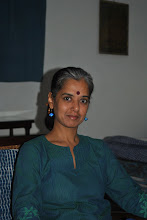
My grey look

Pretty early in life, my hair started turning grey. I was not averse to keeping it that way, but people around me ( not my husband and children) objected vociferously. I gave in and started getting my hair coloured. The monthly trips to the beauty parlour to get this chore completed were a drag. The chemicals and unhygienic conditions that I subjected my hair to were strongly resented. I hated the self-imposed pressure to visit the parlour once the grey roots had started making their appearance. And worst of all was making a beeline for the parlour just before a family function or party. It seemed extremely important to conceal the fact that one's hair had greyed prematurely. So presenting one's best dyed self was de rigeur.
Truth be told, I did enjoy receiving compliments on my 'young' looks. I even experimented with streaking my hair to a shade of burgundy. My husband enjoyed it when people asked him if I were his daughter. I could only gape open-mouthed at the poor vision of those people.
I enjoyed the comments for a few years. But only till my children grew taller than me and my son started sprouting facial hair. It no longer pleased me when people said, "Oh you don't look like you have such grown-up children".Then one day I realised that I was actually waiting for that comment from the person to whom I had been introduced two minutes back. And that I was disappointed when the comment did not come. That was the wake up call for me. It dawned on me that I had turned into a vain pretentious middle-aged woman, taking her 'young' looks for granted and hooked to people's comments on her physical appearance.
And since that day I have become a member of the 'Glad to be grey' club. I have stopped visiting the parlour for the hateful chore of colouring my hair. I now feel a total sense of freedom. No pressure at all. I proudly carry my speedily-turning grey pate to family functions, weddings and parties. The whole experience is new and I am still enjoying the journey. There are days when I am not so happy looking at myself in the mirror. The other day I was looking at some old photographs and the thought did pass my mind that may be I could have waited a few more years before going au naturel. But I am surely not reverting to the old bad habits. Right now I am motivated by the thought that I am among the few women courageous enough to go against a trend. I smile in solidarity when I pass by elegant-looking women sporting smart grey-haired bobs.
I get mixed comments from near and dear ones. Some people are inspired by my courage.Others say I should have waited till after my daughter's marriage (missing the logic here). Most do not know what to make of it and how to react. I got the sweetest compliment from my aged neighbour who thought I still looked young despite my grey hair.
All this 'business of beauty' does bring several thoughts to my mind.
Why do we women do this to ourselves? Why is it so important for us to 'be with it'? We put ourselves through this immense pressure to look good 24x7. We cannot step out of the house till our eyebrows are shaped, facial hair is bleached, hair on the head is dyed, hair on the arms and legs is waxed and hair in the underarms shaved. We look with disdain at fellow women who choose to stay natural, not interfere with the hair in various areas of their bodies. I would just wish for more celebrities to display the courage of Julia Roberts and not be shy of waving at award ceremonies with the hair in their underarms clearly visible. That would be the day for all of us!
The range of commodities on offer for us has only increased with time. Services now target not just skin-deep beauty, but threaten to alter our basic god-given gifts also. So we now have breast augmentation, lipo suction, laser removal of unwanted hair, lightening of skin colour etc.. "Don't like your thin lips? Voila, we can make them fuller", "Your boyfriend likes Angelina Jolie's pout? We can give you one. He will no longer look at Jolie". Ridiculous!!
Do we want to be so fickle-minded and make commodities of ourselves, neatly-packaged gifts to be offered to the guys? Our self-worth cannot be decided by our physical appearance. We do have more substance than that, in our brains that is! Let us show our mettle by our work, our mental strength, our sensitivity, our intelligence and above all by our honesty. Stop being vain. Be natural. Acchha hai.

Friday, June 10, 2011

It's only words

The Bee Gees sang 'It's only words and words are all I have to take your heart away'.
Their song talks about the power of seemingly inanimate words. According to them words are all that one needs to win hearts.
Taking their premise further, the might of words can be put to a lot of good. A pauper can achieve all that he wants through the strength of words alone. A student can top exams by using the right words. An employee can get out of a tight spot by speaking placatory words. Wars can be won solely by the intelligent use of words.
Amazing, isn't that a vision to die for! No use of arms and arms, but people only talking to each other to resolve their inter-personal conflicts. Protesters engaging in talks with the government; Israelis and Palestinians using words to resolve their centuries-old land issues; the governments of Pakistan and India dialoging with each other; Americans in talks with Al Qaeda terrorists. The world would be so peaceful and simple.
If words yield a power greater than arms and weapons, why then do talks fail? What is missing in the communication between the concerned parties?
Words are words. They mean nothing unless accompanied with a thought force. One may be greeted "Good-morning"by a colleague and be left totally untouched in every way. On the other hand another colleague can infuse you with energy by his greeting and you may actually believe that he wishes you to have a good morning. He has communicated more than just a routine "Good-morning". His wish has the power and aspiration to indeed make your morning good.
Words are just the external form, the covering to our thoughts. Words are secondary to achieving an effective communication. The greater, stronger, more precise and clear the thought force, the more the chance of being understood by people who are able to receive that force. On several occasions one experiences a telepathy with certain people, where the spoken word is entirely inconsequential. The exchange with these special persons is possible just by thinking a particular thought and it seems to be conveyed. On the other hand there may be people with whom one could be using a plethora of words and still get the feeling of not being understood. The thought force behind the words does not enter the consciousness of this listener at all, leading to the gap in communication.
Words being words are open to various interpretations. When an understanding of the communication is derived only from the form of the words used, it can lead to misinterpretation and confusion. I may be accustomed to use a word in a certain fashion and with a certain meaning, while the other person may add his own interpretation or significance to it, obviously leading to a breakdown in talks. Drawing an analogy between clothes and words- just as we use clothes to dress ourselves up, words are used to dress up our thoughts. Just as one can use different colours, textures and types of clothes for dressing; one uses different words, languages and intonations to express thoughts. Judging a person by his clothes alone can be as misleading as judging a thought just by the words used to cover it up.
So, that's it. Finally, it's only words. Your tools. To be used as you wish. You can add power to them by the force of your thoughts. Bring about happiness and calm with the force of positive thoughts. Or cause mayhem by using negative thoughts to carry them. Or you can choose to communicate by not using them at all. Conveying thoughts wordlessly. Using precise words to convey a clear thought. Looking for the thought behind the spoken word.
Or like me, you can use words to write a blog and convey your thoughts.
( The idea for this post originated from a conversation with my daughter. She shared that when she was small she felt that the words and names she used for objects were her own. This led to a discussion about how all conversation between people was subjective and depended on the vocabulary, understanding, expressiveness, listening skills of the people involved).

Tuesday, February 1, 2011

An ode to my husband

It never was love at first sight. And not even several sights after.
For the entire engagement lasting several months, the quiet prayer was for freedom from the betrothal.
The sole encounter during the long engagement period ended in copious tears shed by both the aggrieved parties.
As the wedding date neared, the pressure to generate positive feelings towards the soon-to-be-spouse took centre stage.
Promises were made from both sides to mould one to be the dream partner for the other (ugh!).
And the plunge into the ‘saat-pheres’ was taken.
How could one be married and not speak the 3 magical words that one had been craving to declare to the chosen one, whoever that may be.
With an ‘I love you’ mumbled on the first night, the journey of my love for Sharad began.
From that first under-pressure expression of love, our love has now traversed 22 years worth of travel miles together.
When and how did that hateful stranger metamorphose into my ‘soul mate’, I cannot fathom.
But I do know exactly when I realized that I loved him.
3 years and a baby later when I saw him sit all day at my hospital bedside.
Of course that in no way means that it has been smooth-sailing ever since.
Fed on notions of Mills & Boon-inspired romance, the expectations out of my first love were immense.
And truth be told, he has always been very sweet, sensitive and romantic.
A good deal half-baked though in the emotional maturity levels.
Every so often there were angry outbursts of misunderstanding, impenetrable walls of silence, vile meanings attached to innocent words.
Being the single emotional anchor for teenage kids was no cakewalk.
Living life at different spiritual levels had become the accepted middle path.
Till he reinvented himself as my “soul mate” and brought magic back into our lives.
My knees turn to jelly again when I see him- potbelly, grey hair, reading glasses and all.
I laugh at his silly jokes and melt when he sings songs only for me.
We crave each other’s company and have several meaningful conversations about anything and everything.
The romance is back and is very much here to stay.
It is now a very well- baked, hard-crusted relationship with the sweetest of cores.
Kudos to that!!!

Tuesday, January 18, 2011

The bead bag

The story of the bead bag begins way back in 1976 when my family- mom, dad, brother and a 10-year old me, were on a trip to Hong Kong. My mom bought several colourful bead bags to gift to relatives and friends back home. The bags were more or less similar, ladies' multipurpose fabric drawstring bags with colourful beads pasted in attractive patterns on a black background- chirping birds on a tree, dancing peacocks, galloping deers. By and by, most of the bags were gifted except the bag with the pattern of the galloping deers. For some reason this particular bag stayed with my mom, unused, for the next thirty years. It was one among many of her 'prized possessions', objects which she found too pretty to use. All such purchases were looked at and admired every once in a while, replaced in the polythene they were kept in and stashed away in her special cupboard for 'dene-lene ka saaman'.

Thirty years later, in June 2006, I was visiting my mom with my husband and kids. During our brief stay with her, she fell ill and was advised immediate surgery for which we decided to bring her back to Gurgaon with us. Somehow the colourful bead bag made its way into her hurriedly-packed suitcase. The thought being that she would gift it to Nishita, her grand-daughter and my neice, who would now be visiting her 'dadi' in Gurgaon rather than in Mumbai.
One thing led to another. Mom's health deteriorated beyond anyone's worst nightmare. She battled cancer and it's related side effects. Health and recovery took precedence over thoughts of passing on the bead bag. Once in a while she did mention that I should use it. But the bag stayed in a corner of her cupboard shelf. And that is where it stayed when the end came ten months later.
Feeling an attachment for the bead bag I kept it for myself. She had wanted me to keep it, I reasoned to myself. It took me a year or so before I actually got around to using it. And the first time I slung it on my shoulder, the fabric strap gave way due to decay. Disappointed and remorseful, I put it back into the cupboard. Till one day I got a brain wave and decided to replace the fabric straps with cane handles from an old bag. Voila! The bead bag was now ready to be used in it's new 'avataar'.
And that is how I have been using it ever since.
Each time I have taken it out, people have remarked at it's beauty and uniqueness. Children have loved the colourful galloping deers on it. Strangers have complimented me for carrying 'such an attractive bag'. The compliments I have received for that bag have not ceased.
And when people ask me about where I got it from, I always enjoy telling them the entire story.
The bead bag has taught me an invaluable lesson.
I have learnt to multiply the value of all 'prized possessios' by sharing them with the whole world. I have learnt to multiply my joys bymaking everybody a part of them.
I believe that the reason my mom wanted me to keep the bag for myself was because she was sure I would spread beauty and joy in the world by using her bead bag.

Wednesday, July 21, 2010

A global India????

Globalisation!

A global India!

In what sense?

Does the ever-increasing numbers of outward-bound indians, qualify for India being a global nation?

Does availability of brussel sprouts and thyme with the local green grocer make India a global nation?

Does the surge in numbers of 'World Schools' in our metros make us a global nation?

Does making films with Hollywood-style special effects make us global?

Does learning to eat funny-named dishes from all over the world make us global citizens?

Still wondering!

What is it that made us call ourselves a global nation?

What is it about us that made the world ordain us a future superpower?

The average indian still sleeps on the pavement, eats and shits on the pavement.

The average indian is still unaware of the happenings around the world. ( So, of course he is unaware that he is a citizen of a future superpower and must talk and behave a certain way).

The average indian still struggles to make a living.

The average indian persists being a pawn in the larger game of governance. He has no power over his destiny which rests in the hands of the rich and mighty.

On the other hand, the above average indian lives in a world of make-believe. He lives in India but pretends he is abroad.

He lives in apartment blocks with names like 'The Close'; his apartment is centrally-airconditioned with a jacuzzi, a garbage -chute, CCTV cameras and a lot of other trappings that he once fancied in his NRI cousin's house.

He sends his young children to a school where they celebrate Halloween and Thanksgiving.

For higher education he sends his older children abroad- US, UK, Australia, NZ anywhere abroad will do.

He spends every vacation abroad, each time a different exotic destination so that his children soak up the culture of the place.

He and his family are as alienated from the supposedly 'future superpower i.e. India' as the average indian on the pavement.

Is there really someone out there who is still proud to be living in the country of his birth?
Doesn't seem like it!

The man on the pavement realises that hard work is his only salvation. His sense of pride comes from being able to feed his family two square meals a day.
The above average indian is anyway only 'passing his time ' in India, in between vacations abroad. He uses the first opportunity he gets to bad-mouth India.
It is finally the middle class indian who is weighed down by all the feelings of 'pride for country'. He is the educated, thinking indian who is aware of the country's rich culture etc. and takes pride in it.
He believes to his core that India is actually capable of becoming a 'future superpower', more so because he sees himself as being the cause in the matter.
He instills pride for the country in his children by sending them to schools instilling indian values and culture.
His children go on to study in the best indian institutions of higher learning because he believes that these are superior to any institution abroad.
He religiously pays his taxes, abides by all rules and regulations, knowing no other way of being.
It is he who participates vehemently in media debates about where the country is heading and what the government should be doing.
Consequently it is he who feels the greatest shame with the entire CWG mess.
He is the one who feels the most let down by the manner in which the national pride has been vandalised.
Is this the use to which his hard earned money has been put to? Has it filled the bank accounts of Kalmadi and Co..?
There could have been a million different developmental projects accomplished with 70,000 crores.
A million different dreams fulfilled, a million different smiles distributed.
What could have been!!!
Is there any point to this debate now?
Have we not brought this upon ourselves?
Pride in our 'chalta hai' attitude! CRAP!!
Has it not led us to this day?
We no longer strive for excellence in anything, 'coz we take pride in 'sab chalta hai'!
Sad state to be in. Really hopeless situation for every 'proud indian', the true indian!

Saturday, August 22, 2009

My Dad and me

As far back as I can remember I was always my dad’s pet. When I was little, he loved to apply artistic “bindis” on my forehead. When I was 7-8 years old, I remember my dad feeding me dinner with his own hands as I had a habit of dozing off at sharp 9p.m. with my dinner untouched most nights. That was also the age when I was struggling with Maths at school – especially fractions. Sundays were then spent getting the concepts right from an old class3 Maths textbook, even though I had moved to class4. Once Dad joined Air-India and was away on flight duties, he always made sure that there was something for me in his suitcase when he landed back. Much to the chagrin of my brother, the clothes that Dad brought back for me always fitted me perfectly whereas the ones bought for my brother invariably ended up being the wrong size. On Dad’s first international flight (which was to Hong Kong) he promised to bring me a doll, the kind whose eyes could open and shut. He kept his promise even though he had to pay a heavy customs duty for doing so. Innumerable moments that seemed ordinary back then, have gathered sheen with time. Memories of times gone by that I now want to hold on to and prevent from slipping and getting lost in the crevices of my mind.
There never seemed to be a need for the spoken word when dad and I were together. We could exchange a quick glance and empathise with each other when Mom was being overbearing. We could listen to Mehdi Hassan ghazals endlessly, Dad educating me on the nuances of the ghazal.
There were however two episodes in my life when our so called telepathy failed, creating a silence between us that was palpable with tension. One was when I chose not to take up medicine as a career and my father was hurt enough to say “You sabotaged me”. The second episode involved his choice of a groom for me and my feeling hurt that he had not considered my point of view while doing so. We made our peace after each of these episodes, again in an unspoken sort of way. My son, his first grandchild and the apple of his eye, mended the path for us, as only little children can do. My father found occasions to say “I am proud of you” which I took as his way of redemption. By finding happiness in my marriage to the groom of his choice I found a way of saying “All is forgiven”.
My annual trips to Bombay where my parents lived were always full of days planned with Mom as is mostly the case with mothers and married daughters. Dad was always around to take care of his grandchildren, whom he just adored. He was as connected to their childhood as he was to mine – aware of their friend’s names, their interests, their silly games. He would book tickets in advance for movies of their interest – Batman, Harry Potter, Stuart Little. But there was always a pall of gloom on the day of my return journey. It was always the same: he would not leave his room and when I mustered the courage to enter, I would find him seated on his chair staring into space with a sad expression on his face. I always got the feeling that he wasn’t sure if he was going to see us again.
The news of his having contracted cancer came as no surprise to him or to me. He had been losing weight and his pancreas had been malfunctioning for quite some time. He struggled with his chemotherapies with a lot of grit and stoic, taking all that the disease entails in his stride, not giving up hope. That year I was working in a new job and could not be with him as much as I, and I am sure he, would have liked. And that has been my biggest regret to date. Why did I not take a stand in time and be there for him, when he needed me? Why did I not sense his unspoken need for me? Having let him down will be one of the crosses I will have to bear for life.
I spoke to him 3 days before he expired to wish him for Holi. He asked me when I was coming. I said the earliest that I could make it was by the end of the month and he said that was too late. And true enough, it turned out to be too late. He had slipped into semi-coma the day after Holi, unaware of anybody’s presence around him.
I would like to think that he knew of my presence by his side even when he was in that state; that he lay there and blessed all his family, thinking of and blessing each one of us while he lay there motionless. Maybe I can even dare to hope that he forgave me for not living upto all his expectations.
I can never know for sure but I yearn for a message from him each moment, looking to connect with him in our very own “unspoken” manner.
But most of all I miss his hand on my head, a gesture that reaffirmed my belief in myself, a gesture that said “I will be there for you always, no matter what”.

Saturday, July 4, 2009

Gurgaon's traffic woes

We live in Gurgaon. The "Millenium" city of India. The "Singapore" of India. The "Mall" capital of India. Wow! Living in a city with such a colossal reputation should indeed give me an euphoric feeling, an "out of India, foreign country" kind of feeling. But I feel anything but that.


Whenever people get impressed with our address, I do not know how to react. Am I to feel proud and wax eloquent about the place or should I just get them acquainted with the woes at ground level. Because one thing is for sure, the comments about the city are all to do with it's tall glass and chrome buildings.The unseen reality on the ground is a different story all together.Gurgaon is as distant from Singapore as a yak is from the streets of Delhi.

The city has grown vertically at such a fast pace that the infrastructure has not been able to keep pace with it. HUDA has been firefighting a losing battle ever since they opened their city to private builders. With fancy apartments and world-class condominiums comes a population that has experienced the best the world has to offer and their expectations from the city match the height of the towers they reside in.They choose to live in India but pretend to be living in New York!

Gurgaon also has the reputation of being the IT hub of the north and the call-centre capital of India.Which means that the local junta is an educated lot. But the way they drive their "Civics and Corollas" belies that. They drive like they know not what the red light stands for! Seriously Gurgaon could easily be the "chaotic traffic" capital of the country. Each driver drives at his own whim and fancy; choosing to ignore the traffic lights, the fellow drivers, the scarcely present traffic cop, the existence of footpaths, road dividers or even pedestrians.
My immediate concern is the traffic light right outside the gate of my apartment block. The apartments are on the "mall mile" of the city and hence prone to traffic snarls. U-turns at the traffic crossing were blocked by the authorities for better flow of traffic. Drivers had to take a u-turn a little further ahead. But as each driver drives and turns at his convenience, a few rule-breakers/ path-formers chose to go over the kerb and form a turning of their own. They became the trend-setters and it became the norm to drive over the kerb. Over time the kerb ceased to exist and there was a huge pothole due to frequent mauling by SUVs. Every kind of vehicle passed through that haloed pathway even though it's rear wheels threatened to get stuck in the, now huge, pothole. When the authorities placed huge concrete blocks to block the, now common pathway, the irate drivers formed another turning a little short of the previous turn. The situation is still the same.
Being a law-abiding and rule-following citizen I find myself in the minority when I choose to take the turn at the designated spot. I feel like a righteous "goody-2-shoes" who will not do any wrong. Why does following rules/ doing exactly what I am expected to do, make me feel like a loser? I would like to do more about this situation than just write a post on it. Would a human chain at the spot help change the rule-breaking habits of the people? I would really like inputs to tackle this situation.
Do people even realise that by harming public property, in this case the kerb, they are actually paying for it through the heightened taxes imposed by the government. Finally the buck always stops at the tax payer, the aam aadmi. Our short-sightedness will eventually be our undoing in all things. "Living for today" is the modern man's mantra and all our problems can be traced back to this root cause. Just think about it.

Wednesday, July 1, 2009

Learnings from the "Painturewallah"

Sorry for being away for this long. In the 3 months that I have been away I have made a few self-discoveries. I have realised that working full-time is not my cup of tea. I enjoy the freedom of deciding every morning what I would like to do with the unfolding day. I detest the idea of "job commitments" taking away that decision from me. I am loathe to letting a job keep me away from all that I love doing, blogging included.

The other day I had a flat tyre and I took the car to a road-side "Painturewallah". It was extremely hot and I was not looking forward to the time I would have to spend in the heat while the car was being repaired. All of 5 minutes actually, 10 to the maximum. I looked at the young man working on my car. He seemed to be a teenager, probably my son's age. He was dressed in a tee-shirt and jeans which were completely black with grease. Obviously. I was being careful to not let any part of my clothing accidentally brush against him, lest it gets dirty.

And then the cruelty of my behaviour hit me. This guy was helping me do a job I was ill-equipped to handle myself. I had neither the strength nor the expertise to do the job I had entrusted him with. And yet I was looking at him disdainfully. Agreed his working conditions were pathetic and his overall appearance was filthy. But didn't the nature of his job require him to be that way. Why was I judging him by his appearance and not by his competence at his job?

We look down at people doing manual labour. They are the people consigned to the bottom of the heirarchy of workers. They are the ones with whom we haggle before paying them their due. We use phrases like,"Bhaiya, is kaam mein kya hai? Yeh toh koi bhi kar sakta hai"; "Itne se kaam ke itne paise?". It's like we are the experts at the job and not they.When you consider that these are also the people who are struggling to scrunge up one square meal a day,one really amazes at the strength they display in accomplishing their tasks which are physically demanding to say the least.
All of us living in our fancy homes and moving in our fancy vehicles cannot function for a day without the presence of these faceless people around us. And yet we do not value their work nor do we acknowledge the importance of their being. To us they are just the scum of the earth who are out to cheat and steal from us when our guards are down. To us they are the illegal encroachers of valuable urban space.To us they mean nothing as individuals.

Like the cart-horse Boxer in George Orwell's Animal Farm, these are the people who are happy doing their jobs, firm in their belief that one day their lot will improve. They are sure that all they need to do is work harder and harder for that to happen. And that's what they do.

Are we as convinced of our jobs as they are of theirs?

Saturday, April 11, 2009

Blood Donation-My Personal Journey

As part of being the caregiver to a cancer patient, I experienced firsthand the helplessness that most caregivers feel when their patient is in dire need of blood and they cannot find donors. In several instances a bottle of blood is really the savior of life. You can literally see your patient's condition change for the better after that blood infusion. And you really want to touch the feet of the donor for the noble act of donating blood for your patient. But finding an eligible donor is the main problem.

It is at these times that you realize that India isn't really a nation of healthy people. There are very few people who are 60 or even 50 and not on medication of any kind. So they get ruled out as donors. A lot of the middle-aged people i.e. the 40+ group begins to complain of either hypertension or diabetes and you are lucky if you can get a donor in that age group. And the younger lot, i.e. the 18 and up, well very few of them are in the country, and those that are there may be unavailable to donate due to various reasons. The women are mostly anaemic. So inspite of a huge population India remains a country where the paucity of potential donors is huge.

We also happen to be a people living in the dark ages when it comes to our awareness about blood donation. We still have a lot of mind blocks- why should I, others will do it; it is for the rickshawallahs to do it; I may get infected with AIDS etc.; it may lead to weakness; it is time-consuming; it is painful!! Indifference is the biggest malaise of the nation presently, and indifference in this area is really costing us dear.

It was while I was going through the harrowing time of finding suitable donors for my patient did I resolve to become a regular donor myself. I have been able to donate blood thrice since then and would really like to see the Khoon Chooson Aandolan become the lifeline to all those in need of blood.

I am an ordinary lady. I don't consider myself very fit or very strong. I weigh 50kgs on a 5'3" frame. I have my frailties, my aches and pains. And if I can donate blood every 3 months and not be the lesser for it, I think anybody can. It is the easiest hospital experience ever. It is such a rare sight for hospital authorities to come across voluntary donors that they treat you as royalty when you walk in for that purpose.There is just one form you fill up where they want to know about your previous ailments, if any. Then they check your weight, height, blood pressure, blood group and Hb. In fact you can take it as a free medical check-up because they test your blood for various parameters and even mail you the reports if you ask them to. The entire experience may take maximum half an hour. The actual blood donation takes less than 5 minutes. And you also get free juice and a snack after the donation. All the times that I have donated I have really enjoyed the experience and come out feeling very altruistic. And I didn't have to spend a penny to get that feeling. I have probably saved somebody's life with something that I will not miss, for which I did not spend anything, that which I will be producing more of in a short time again. And once that is done I can go back and save somebody else's life again.

The way I see it - Nobody is a loser in this bargain. Everybody gains from the exercise!

So don't think about it too much. Just walk to the nearest hospital with a blood bank in your area and experience the life-altering miracle for yourself.

Spread the word. Be heard. Donate.