Thursday, August 1, 2013

Homo Sapiens Moderna, Part 1

Homo Sapiens Moderna, the modern man, is an impatient being.
With each new generation, his level of intolerance for all things 'slow and steady'  is escalating. He has condensed his communication and discovered newer and faster ways of accomplishing tasks. The old and laborious procedures to tasks have faded from memory all together.
This post is not merely about all things old versus their new avatars.
This post stems from an anxious belief that the genetic makeup of our future generations is getting modified to include 'impatience' and 'restlessness' in its prototype.
The present generation, without even realizing it, has brought about changes in his environment through his inherent 'shortage of time'.
This is an attempt to list 100 different areas where the modern man has made his 'fast and furious' ways the norm. (Since it will be a long list, I will be covering 5 areas in each post.)
1. Medical care
In the olden days not so long ago, one went to a neighborhood doctor's clinic when one was sick. You waited patiently for your turn on a wooden bench in the waiting area.The doctor took his time in exchanging pleasantries and examining you. He had probably already built a rapport through previous visits and knew all about your school life and friends. He had a compounder who was equally friendly and caring and who helped you understand the dosage of the medicine that he had packed in a paper packet. The medication was always arranged by the doctor and it always made you better. We all know what the modern medical scene is. The friendly neighborhood doctor has morphed into a multi-specialty clinic where doctors come and go, prescribe medicines to be bought from the market and the question of a rapport developing between the patient and the doctor does not arise because the next time you visit, the doctor would have stopped coming to that clinic.
2. Diagnostics
If medical care has changed, so has diagnosis of illnesses. Where earlier one relied on the competence of the doctor to diagnose through his physical examination, the modern doctor does not exercise his expertise of physical examination due to time constraints. A battery of tests is what aid him in his diagnosis. The doctor outsources his work of diagnosis to the pathology lab so that he can attend to a larger number of patients. It is believed that diagnostic tests are a sure-fire way of ensuring quick diagnosis and treatment.
3. Medication
A doctor who can cure a patient quickly, is the best. Who cares if he prescribes strong medication or even recommends usage of steroids for young children. We begin to mistrust a doctor if he is unable to cure our patient quickly. This restlessness has led to a horde of wrongful medical practices which the patient remains unconcerned about.
4. Cooking
Our grannies spoke about cooking on the 'choola' and the 'angeethi', slow and cumbersome processes. Our parents hastened the cooking process by using stoves and cookers and then LPG gas. Our generation saw the advent of microwave cooking, a faster way of cooking. Foods like paranthas, pakoras, samosas were still cooked from scratch. Frozen pre-cooked foods are the future of modern cooking. Even cooking on the gas or in the microwave is considered time-consuming in a modern double-income household. So a modern mom earns brownie points from her family for serving market-bought 'dahi', reheated potato wedges, packet-made idlis, bottled 'chatnis' and pickles, ready-to-eat 'matter-paneer' and 'biryani'. The task of making 'mathris' and 'ladoos' for festivals now rests solely with the local 'halwai', what with the households now engaged in other festive recreations.
5. The way we eat
If what we eat has changed with the fast times, how we eat has also taken giant leaps. 'Grab-a-bite', 'working lunch' are the modern ways to eat. Meals chewed and mulled over friendly family banter have been replaced by TV dinners. Oh, it is so boring and old-fashioned to have a sit-in meal. Instant mood highs through food has led to an increased consumption of comfort foods like chips, chocolates, cookies etc.
Part 1 concludes with these 5 areas.
Please feel free to add your thoughts to the list.
Waiting patiently to share 5 new 'impatient' areas with you tomorrow. Ciao.  

Thursday, November 1, 2012

A day

A day.


Just that. 24 hours.

What makes a day memorable?

How is one set of 24 hours distinguishable from the other?

As I spend my days recouping from a surgery I am pained by the sameness of my days. They blend into one another, marked only by the slight shift in my physical well being. Groggy bye to daughter, waking up at 8, washroom, coffee, newspaper, bye to hubby, newspaper again, a long stretch of reading books and magazines, medicines and meals and meals and medicines till it is finally time for sleep again. End of day 1 and 2 and 3 and 4.....

This bored routine got me thinking about what is it that makes one day different from the other?

Our experiences through the day, the people we meet, our thoughts, feelings and insights through the said experiences can differentiate our days. But why are some days memorable while others are not? Is being present with your heart and soul to every moment of your life the key to relegating them to memory? If a spiritual being is always present to all his experiences every day, is it humanly possible to remember all those moments of every day, 24x7?

So, what are my most memorable days?

Age- nearly 46. Days on earth- roughly 16,790.

Which one of those days has been stored on the hard drive of my memory in its entirety?

Snatches of memorable moments are plenty. Some are revisited through sepia-tinted photographs. Others are stroked and caressed when they pop up aided by a trigger. Like the sight of white and pink periwinkle flowers brought on the smells and sounds of childhood visits to the Bardhan household, meeting ageing 'Mataji', her caretaker Savitri and eating the beautifully molded 'sandesh' offered by them each time.

School and college life, growing-up pangs, birthdays, friendships, the several firsts- first rank in class, first stage performance, first sari draped, first day at college, first crush, first night, first night of motherhood........ Oh God! All of them add up to a chest full of memories. Sweet, dear, irresistibly attractive and magnetic.

But a complete day confined to memory? Now that requires some thinking.

In fact there are two memorable days that skim to the top from the huge cauldron of stored data.

First, the day spent seeing the sights of Central London on foot.

Second, traversing Manhattan.

What really stands out about both these days is that I was visiting the places that I had read and seen in travelogues. There had been a longing to walk the streets, see the sights and feel the pulse of both these cities. Actually being there and setting eyes on those famous landmarks made the experience magical. And visiting them with my husband and children completed the picture for me.

Even after more than a decade I can feel the excitement of walking all the way from London aquarium, across the Thames Bridge, past Big Ben and Westminster Abbey all the way to Harrods. I remember standing for a moment in front of the Abbey to recall scenes from Prince Charles' and Lady Diana's wedding, reading famous addresses on the plaques outside houses on the way and peeping into the lit living rooms to catch a glimpse of the charmed 'English' life as witnessed in various British TV serials. Seeing Harrods from the outside (for we could make it there only after closing hours) and then taking a ride in the famous London cab were the final pegs that attached this day to memory forever. Two recalcitrant, grumpy and tired children included.

The day in Manhattan was similar in nature. Travelling in the century-old New York subway, being at Statue of Liberty, witnessing the World Trade Centre pit, looking wide-eyed at the news stations at Times Square, sitting under the trees of the famous Central Park seen in so many movies, spotting well-known hotels, walking past stores only read about in Vogue and Elle. I recall almost feeling a kind of pressure to take in all the sights and confine them to memory in order to be revisited time and again. Well it worked, didn't it! I even remember how that day began, the breakfast of bagels and jam, the hunt for a vegetarian lunch, the apples bought for a dollar each, the mementoes bought with the awesomely exhilarating feeling of being in the Big Apple. The tremendous capper to the day was a fleeting glimpse of Bill Clinton as he was leaving the store Barnes and Noble where he was reading from his recently released autobiography and where we were only 'being there'.

There is no deeply spiritual reason for these two days having turned out to be so memorable. I think the lead up to both these days has a big part to play. The anticipation of being there in person heightened the senses with which the two places were experienced and hence made the visits unique for me. Or it may be because I have the soul of a traveller. A soul seeking to connect with and attatch to memory all the interesting sights in this beautiful world.

Tuesday, April 3, 2012

Violations

Doesn't a common man feel violated all the time?
The laws talk about violations as offences that need to be dealt with in court- traffic violations, sexual violations, copyright violations etc etc.
Are these the only forms of violation?
I contend that an average person on the street is seriously violated 24x7.
A self-respecting, law-abiding, humane individual cannot walk the road without feeling violated in every way.
His sense of peace and calm is violated by the cacophony of blaring horns.
He feels a constriction of physical space, thanks to the crowds around him all the time. Jostling with people of all kinds is unnerving and an assault on so many senses.
Are not footpaths his own patch of public space where he should be able to walk unheckled? But firstly, there are very few such spaces and out of the existing footpaths, parts are broken or are reduced to mud piles or encroached upon by street vendors. So where does he walk?
If he decides to cross the road only on the zebra crossing, again he has no such luck.Vehicular traffic has the right of way here. He can cross only when the vehicles permit him to. But wasn't the zebra crossing his space for crossing? Then why is he being violated in the usage of his own public space?
When inside 'his' space, his home, the violations do not cease. The constant sounds of traffic and horns are his companions day and night. The auditory violation is intense. The policewallahs danda makes his existence on the street a constant struggle for survival.
He has no control over these violations on his being, inside and outside his home.
Where should he go for peace and quiet?
Does he not ask, "Where is my own space?"
The space where I can walk freely. The space where I do not have to look over my shoulder every second for a fast-approaching car or for an on-the-prowl-pickpocketeer. The space where I can breathe fresh air, talk without screaming or repeating. The space where I walk without fear of being castigated for coming in the way of a vehicle. The space that allows me to be a self-respecting, law-abiding humane individual.
Does this space really exist for an average Indian on the street?
Does the constant violation not erode his self-worth and his self-esteem?
Can the pent-up emotions of frustration not push him over the brink to retaliate, take law in his own hands, rebel against those violating him?
For no one remains a victim forever.
The violated will some day violate- all rules and laws to make themselves heard and seen.
Watch out. It may happen to you and to me. Any day.
Give the person on the street his space!!!
Now!!!

Wednesday, October 26, 2011

Happy Diwali to family and friends,

Sharing a few lines penned by my mom on the 'festival of lights'.

In an increasingly market-driven celebration of the festival, these lines convey a fresh
perspective.


दीवाली कुछ हट कर


घर दीवार कुछ मैली हो तो कोई बात नहीं

मन का मैल धुल जाए, तो कोई बात बने


पटाखे फुलझड़ी आतिशबाजी सब प्रदूषण के फंडे

नन्हे चेहरों पर मुस्कान खिले, तो कोई बात बने


ग्रीटिंग कार्ड और तोहफे कह न पाएंगे संदेसे

घर से शिक्षा अभियान चले, तो कोई बात बने


सैंकड़ों झालर की झिलमिल में वो बात कहाँ

उजाला नेत्रदान देकर करो, तो कोई बात बने


ढेरों मिठाई में वो चसक वो मिठास कहाँ

दुखी की कएर दुःख शेयर करो, तो कोई बात बनें


लक्ष्मी-गणेश मुस्काएं, वरद हस्त उठायें

दीवाली यूँ हट कर मनाएं, तो कोई बात बनें

Thursday, June 23, 2011

These are a few of my favourite things

Sharing a few of my favourite things.
Kerala, Goa, Capri,
My favourite hotspots.
It is my dream
to live in a house
near the beach, white picket fence et al
with squirrels scurrying in and out.
( Squirrels on a beach, do they really exist?
Who cares, they do in my dream!)
Reading my favourite book
- Gone with the wind
Sipping coffee, Starbucks preferably
perched on a hammock
under a huge shady tree.
( Shady tree on a beach!!)
Or maybe solving word puzzles
Scrabble, Hangman and Codeword
on the perch of my bookshop
- The Children's Bookshop.
And guess what,
it begins to rain.
Bringing with it the smell of wet mud,
the cool showery watery breeze,
the sound of dripping raindrops,
the fresh clean-looking leaves,
the promise of samosas and pakoras, bhuttas and garma-garam idlis.
Drizzling, drenching, pouring
totally invigorating.
Sometimes it may rain enough
to create a waterfall in the hills afar.
Paintbrush in hand,
I will try and capture it all,
Rains, waterfall, squirrels, books, hammock and children so small.
Or sometimes, the Sun may come out
colouring the sky in hues pink and blue.
Bringing with it a rainbow,
vibrant, subtle and new.
That's the vision of my idyllic dream
Coffee and colours, children and books, peace and bliss.
A song in the background
'These are a few of my favourite things'.
Tra-la-la-la!!

Saturday, June 11, 2011

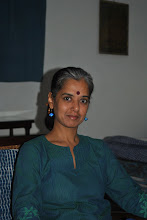
My grey look

Pretty early in life, my hair started turning grey. I was not averse to keeping it that way, but people around me ( not my husband and children) objected vociferously. I gave in and started getting my hair coloured. The monthly trips to the beauty parlour to get this chore completed were a drag. The chemicals and unhygienic conditions that I subjected my hair to were strongly resented. I hated the self-imposed pressure to visit the parlour once the grey roots had started making their appearance. And worst of all was making a beeline for the parlour just before a family function or party. It seemed extremely important to conceal the fact that one's hair had greyed prematurely. So presenting one's best dyed self was de rigeur.
Truth be told, I did enjoy receiving compliments on my 'young' looks. I even experimented with streaking my hair to a shade of burgundy. My husband enjoyed it when people asked him if I were his daughter. I could only gape open-mouthed at the poor vision of those people.
I enjoyed the comments for a few years. But only till my children grew taller than me and my son started sprouting facial hair. It no longer pleased me when people said, "Oh you don't look like you have such grown-up children".Then one day I realised that I was actually waiting for that comment from the person to whom I had been introduced two minutes back. And that I was disappointed when the comment did not come. That was the wake up call for me. It dawned on me that I had turned into a vain pretentious middle-aged woman, taking her 'young' looks for granted and hooked to people's comments on her physical appearance.
And since that day I have become a member of the 'Glad to be grey' club. I have stopped visiting the parlour for the hateful chore of colouring my hair. I now feel a total sense of freedom. No pressure at all. I proudly carry my speedily-turning grey pate to family functions, weddings and parties. The whole experience is new and I am still enjoying the journey. There are days when I am not so happy looking at myself in the mirror. The other day I was looking at some old photographs and the thought did pass my mind that may be I could have waited a few more years before going au naturel. But I am surely not reverting to the old bad habits. Right now I am motivated by the thought that I am among the few women courageous enough to go against a trend. I smile in solidarity when I pass by elegant-looking women sporting smart grey-haired bobs.
I get mixed comments from near and dear ones. Some people are inspired by my courage.Others say I should have waited till after my daughter's marriage (missing the logic here). Most do not know what to make of it and how to react. I got the sweetest compliment from my aged neighbour who thought I still looked young despite my grey hair.
All this 'business of beauty' does bring several thoughts to my mind.
Why do we women do this to ourselves? Why is it so important for us to 'be with it'? We put ourselves through this immense pressure to look good 24x7. We cannot step out of the house till our eyebrows are shaped, facial hair is bleached, hair on the head is dyed, hair on the arms and legs is waxed and hair in the underarms shaved. We look with disdain at fellow women who choose to stay natural, not interfere with the hair in various areas of their bodies. I would just wish for more celebrities to display the courage of Julia Roberts and not be shy of waving at award ceremonies with the hair in their underarms clearly visible. That would be the day for all of us!
The range of commodities on offer for us has only increased with time. Services now target not just skin-deep beauty, but threaten to alter our basic god-given gifts also. So we now have breast augmentation, lipo suction, laser removal of unwanted hair, lightening of skin colour etc.. "Don't like your thin lips? Voila, we can make them fuller", "Your boyfriend likes Angelina Jolie's pout? We can give you one. He will no longer look at Jolie". Ridiculous!!
Do we want to be so fickle-minded and make commodities of ourselves, neatly-packaged gifts to be offered to the guys? Our self-worth cannot be decided by our physical appearance. We do have more substance than that, in our brains that is! Let us show our mettle by our work, our mental strength, our sensitivity, our intelligence and above all by our honesty. Stop being vain. Be natural. Acchha hai.

Friday, June 10, 2011

It's only words

The Bee Gees sang 'It's only words and words are all I have to take your heart away'.
Their song talks about the power of seemingly inanimate words. According to them words are all that one needs to win hearts.
Taking their premise further, the might of words can be put to a lot of good. A pauper can achieve all that he wants through the strength of words alone. A student can top exams by using the right words. An employee can get out of a tight spot by speaking placatory words. Wars can be won solely by the intelligent use of words.
Amazing, isn't that a vision to die for! No use of arms and arms, but people only talking to each other to resolve their inter-personal conflicts. Protesters engaging in talks with the government; Israelis and Palestinians using words to resolve their centuries-old land issues; the governments of Pakistan and India dialoging with each other; Americans in talks with Al Qaeda terrorists. The world would be so peaceful and simple.
If words yield a power greater than arms and weapons, why then do talks fail? What is missing in the communication between the concerned parties?
Words are words. They mean nothing unless accompanied with a thought force. One may be greeted "Good-morning"by a colleague and be left totally untouched in every way. On the other hand another colleague can infuse you with energy by his greeting and you may actually believe that he wishes you to have a good morning. He has communicated more than just a routine "Good-morning". His wish has the power and aspiration to indeed make your morning good.
Words are just the external form, the covering to our thoughts. Words are secondary to achieving an effective communication. The greater, stronger, more precise and clear the thought force, the more the chance of being understood by people who are able to receive that force. On several occasions one experiences a telepathy with certain people, where the spoken word is entirely inconsequential. The exchange with these special persons is possible just by thinking a particular thought and it seems to be conveyed. On the other hand there may be people with whom one could be using a plethora of words and still get the feeling of not being understood. The thought force behind the words does not enter the consciousness of this listener at all, leading to the gap in communication.
Words being words are open to various interpretations. When an understanding of the communication is derived only from the form of the words used, it can lead to misinterpretation and confusion. I may be accustomed to use a word in a certain fashion and with a certain meaning, while the other person may add his own interpretation or significance to it, obviously leading to a breakdown in talks. Drawing an analogy between clothes and words- just as we use clothes to dress ourselves up, words are used to dress up our thoughts. Just as one can use different colours, textures and types of clothes for dressing; one uses different words, languages and intonations to express thoughts. Judging a person by his clothes alone can be as misleading as judging a thought just by the words used to cover it up.
So, that's it. Finally, it's only words. Your tools. To be used as you wish. You can add power to them by the force of your thoughts. Bring about happiness and calm with the force of positive thoughts. Or cause mayhem by using negative thoughts to carry them. Or you can choose to communicate by not using them at all. Conveying thoughts wordlessly. Using precise words to convey a clear thought. Looking for the thought behind the spoken word.
Or like me, you can use words to write a blog and convey your thoughts.
( The idea for this post originated from a conversation with my daughter. She shared that when she was small she felt that the words and names she used for objects were her own. This led to a discussion about how all conversation between people was subjective and depended on the vocabulary, understanding, expressiveness, listening skills of the people involved).